
Quantum Machine Learning: Basics
June 19, 2026 • 4 min read
Girls in Quantum
Author
Maria Helena, Independent Researcher & Brazil Ambassador Girls in Quantum
Quantum is the new explosive topic in the industry. After IBM’s quantum computers and the biggest cloud providers — such as AWS, Google, and Microsoft — invested in quantum through the cloud, quantum became the new “hype.” But more than hype, quantum can be truly useful. In this article, I’m going to talk about a machine learning topic that intersects with quantum: Quantum Machine Learning.
What is Machine Learning?
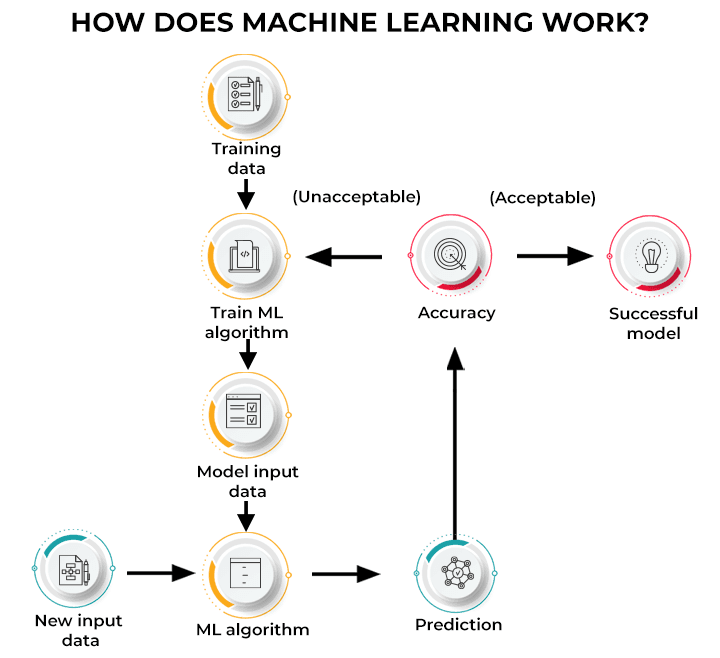
Before understanding Quantum Machine Learning, we must first understand what Machine Learning is. Basically, Machine Learning is the machine’s capability to predict phenomena through learning. It has some key components:
- Training Data: The data that gives the model its ability to learn and make predictions.
- ML Algorithm: The algorithm used to predict the phenomenon (e.g., Linear Regression).
- Prediction: The result of this workflow.
After these steps, we have the evaluation of the model. This step is really important to understand if the model is performing as needed.
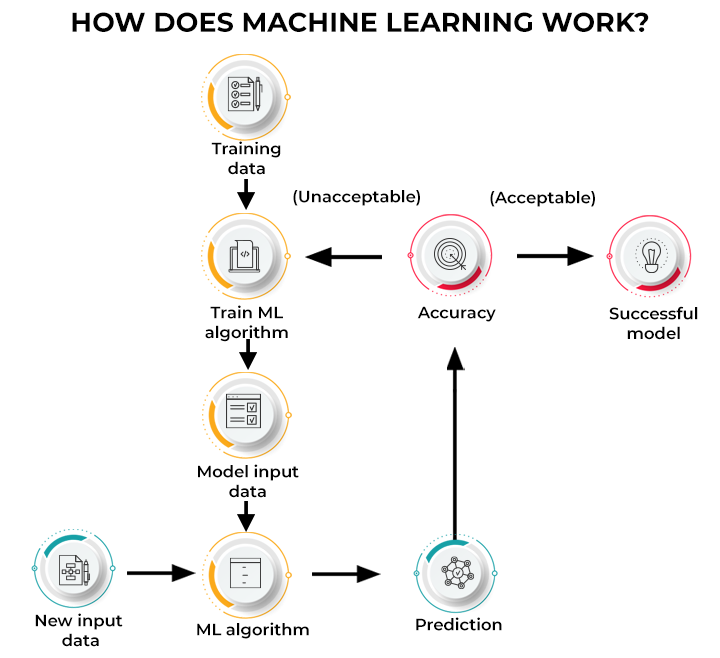
Figure 1 — https://www.spiceworks.com/soft-tech/what-is-ml/
What is Quantum Machine Learning?
After understanding what Machine Learning is, we can dive deeper into this subtopic. Basically, Quantum Machine Learning is the area of quantum computing that leverages the properties of quantum mechanics to give ML algorithms an advantage in learning.
For that, we need to understand the key concepts of quantum mechanics:
Key Concepts of Quantum Mechanics
- Superposition: It is the capability of a quantum bit (qubit) to exist in both states (0 and 1) simultaneously. Traditional hardware cannot be in a superposition state — a classical bit is always either 0 or 1, never both.
- Entanglement: When two or more qubits become entangled, the state of one qubit is directly correlated with the state of another, regardless of the distance between them. This property allows quantum systems to process complex correlations in data more efficiently.
- Interference: Quantum states can interfere with each other — constructively (amplifying correct answers) or destructively (canceling wrong answers). This is a key mechanism that helps quantum algorithms converge toward the best solution.
- Qubit: The fundamental unit of quantum information. Unlike a classical bit (0 or 1), a qubit can represent a combination of both states through superposition, enabling exponentially more information to be processed.
How Does the Learning Happen?
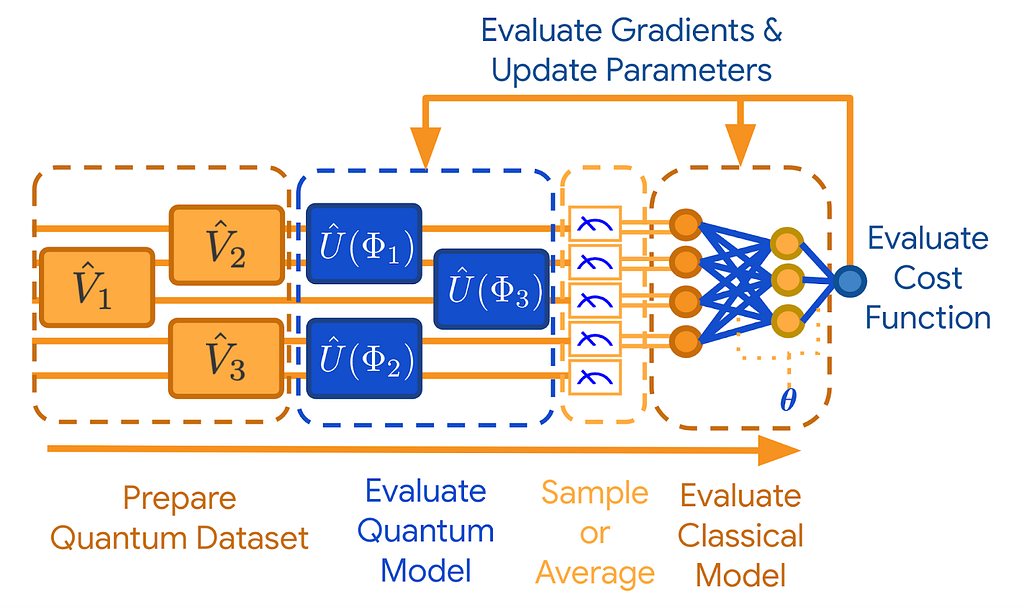
In Quantum Machine Learning, the learning process follows a hybrid approach that combines quantum and classical computing:
- Data Encoding: Classical data is encoded into quantum states through a process called quantum feature mapping. This transforms traditional data points into qubit representations that can leverage quantum properties.
- 2. Quantum Circuit (Variational Circuit): A parameterized quantum circuit processes the encoded data. This circuit acts as the “model”(similar to a neural network in classical ML), where quantum gates manipulate the qubits.
- Measurement: After the quantum circuit processes the data, the qubits are measured. This collapses the superposition into classical values (0 or 1) that can be interpreted as predictions.
- Classical Optimization: A classical optimizer (such as gradient descent) evaluates the prediction results and adjusts the parameters of the quantum circuit. This step is repeated iteratively until the model achieves optimal performance.
- Iteration: Steps 2–4 are repeated in a loop until the model converges, meaning the predictions become accurate and stable.
Why Use Quantum for Machine Learning?
Quantum Machine Learning offers potential advantages over classical approaches:
- Exponential State Space: With n qubits, a quantum system can represent 2ⁿ states simultaneously, enabling the exploration of much larger solution spaces.
- Faster Pattern Recognition: Quantum properties like entanglement and interference can help identify complex patterns in data that classical algorithms struggle with.
- Optimization Power: Many ML problems are essentially optimization problems. Quantum algorithms (such as QAOA) can potentially find optimal solutions faster than classical methods.
Current Limitations
It is important to note that Quantum Machine Learning is still in its early stages:
- Current quantum hardware is noisy and has limited qubits (NISQ era — Noisy Intermediate-Scale Quantum).
- Not all ML problems benefit from a quantum approach.
- Hybrid quantum-classical methods are the most practical approach today.
This was an introduction to Quantum Machine Learning. In the next post, we will talk about Quantum Neural Networks. Thank you for reading!
Enjoyed this read? Support the author onMedium.
Reactions
Responses (0)
Join the conversation
Enter your name to start commenting.
No comments yet. Be the first to share your thoughts!