
Understanding Schrödinger’s Equation
April 13, 2023 • 2 min read
Mohamed Aziz Chebil
GiQ Ambassador

If you ever read science articles or watched Youtube videos about physics, you will realize that Schrödinger’s equation pops out a lot. You might ask yourself:
What is Schrödinger’s Equation?
That’s what we will answer in today’s article.
In a nutshell, Schrödinger’s Equation allows knowing everything we want about a quantum system ( position, momentum, energy, etc…). But we cannot know everything at once based on the uncertainty principle.
Today, we will explore the time-independent Schrödinger’s equation.
ψ(x) :</strong> The wave function can tell you where the electron is likely to be. Note the wavefunction will give you only the probability of where you can find the electron, not its exact position. For sure, different wave unctions will give us different probabilities where we find the electron. Below you find examples of wavefunctions.

E: stands for the energy the electron is allowed to have Albert Einstein was able to prove the following relation.
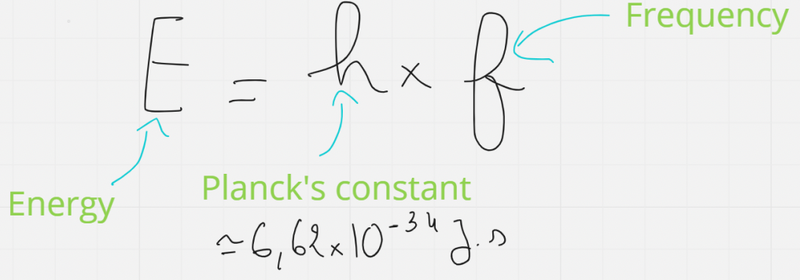
At a quantum state, the energy levels are discrete: they only take quantized values.
For the other side of the equation, the terms represent the potential energy and kinetic energy.
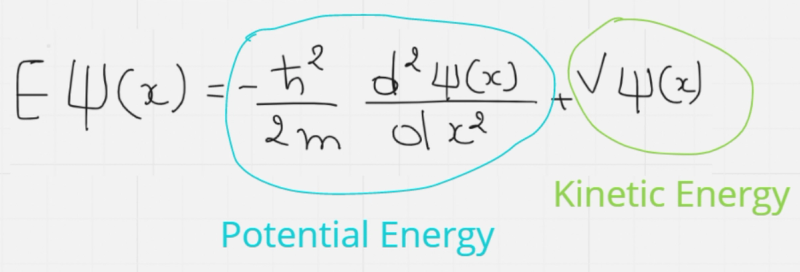
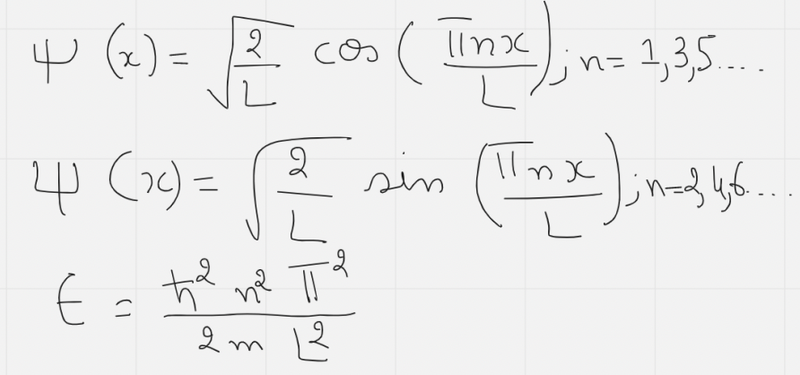
In The Schrödinger Equation, we are looking to find solutions for the energy E and the wavefunction ψ(x). Below you find an example of solutions to Schrödinger’s equation ( the box problem)
Resources:
Check out this book here!
Reactions
Responses (0)
Join the conversation
Enter your name to start commenting.
No comments yet. Be the first to share your thoughts!