
How a Piece of Scotch Tape Sparked my Interest in Quantum Mechanics
November 20, 2025 • 4 min read
Girls in Quantum
Author
By: Brooke Ramey
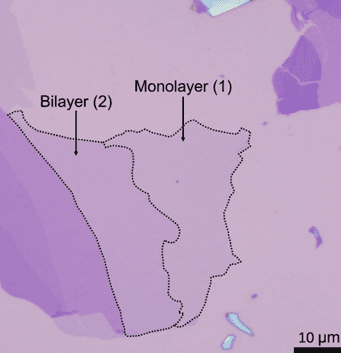
Last summer, I was presented with the opportunity to join a research group at the University of Texas that focused on van der Waals heterostructures, Moire patterns, and the quantum Hall effect. After receiving a crash course in the world of semiconductor fabrication, I was given my very first assignment: to investigate the parameters of mechanical exfoliation of graphene. Thinking my days would be filled with high-tech instruments and sci-fi-esque machinery, you can imagine my surprise when I learned that my primary tools would be nothing more than Scotch tape and a microscope. My task was to use the tape to peel layers of graphene from a bulk piece of graphite and then scan my samples under the microscope, practically crossing my fingers that I had managed to isolate a sheet only one atom thick.
I couldn’t believe that this work, which at first felt like arts and crafts, was part of a global effort to build faster and more efficient technology infrastructure. How could something as simple as tape separate layers of carbon to just one atom of thickness? To be honest, nobody is completely sure, and that mystery was exactly what kept me going. That summer, I didn’t make any extraordinary discoveries about graphene, but what I did discover was even more important: there is so much yet to be understood.
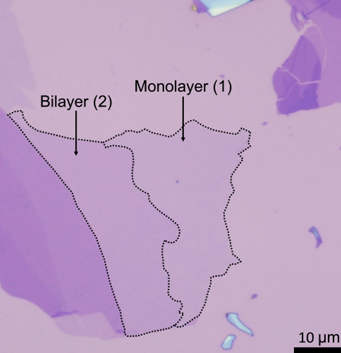
At the microelectronics lab, our group was trying to understand the quantum Hall effect, which could be seen in fabricated devices containing graphene. To briefly get technical, this phenomenon occurs when electrons confined to two dimensions under a strong magnetic field exhibit a precisely quantized Hall resistance, an effect that arises from topologically protected edge states and discrete Landau energy levels. The discovery of this effect was the first physical realization of a topological phase, laying the foundation for topological insulators, superconductors, and even quantum computing materials. As a result, graphene became a quantum playground for physicists and a speed dream for engineers. It blew my mind that something so abstract could hold the key to transforming technology as we know it. And then, to realize that this was just one niche topic within 2-D electron systems, within low-temperature and quantum transport physics, within solid-state physics, within condensed matter physics, then physics itself, and finally science as a whole. This thought was humbling, and for the first time in my life I understood the vastness of what remains to be discovered and the importance of joining that search to help humanity progress, even if it meant playing around with tape in a cleanroom lab. Today, there are many ways to produce graphene sheets just one atom thick, but none yield material with the same pristine quality as mechanical exfoliation. To observe the quantum Hall effect the graphene must be nearly perfect, free of folds, tears, and contamination. Our lab relied on this tape method to ensure the highest possible quality, even though the yield was extremely low, unreliable, and at times felt more like luck than empirical work. Nevertheless, it remains the best method the world has right now. Little did I know, prior to joining this lab, that something as simple as tape could have such immense impacts in the quantum world. Although mechanical exfoliation can be fun in its own, somewhat absurd way, I hope that in my lifetime someone discovers a more efficient means of producing large, high-quality graphene sheets. To achieve that, we’ll need more people in science willing to take on challenges bigger than themselves, and to confront the unknown, one layer at a time.
Enjoyed this read? Support the author onMedium.
Reactions
Responses (0)
Join the conversation
Enter your name to start commenting.
No comments yet. Be the first to share your thoughts!