
The Beautiful Flaw: Why the Math of Quantum Mechanics Might Be Incomplete
November 23, 2025 • 4 min read
Girls in Quantum
Author
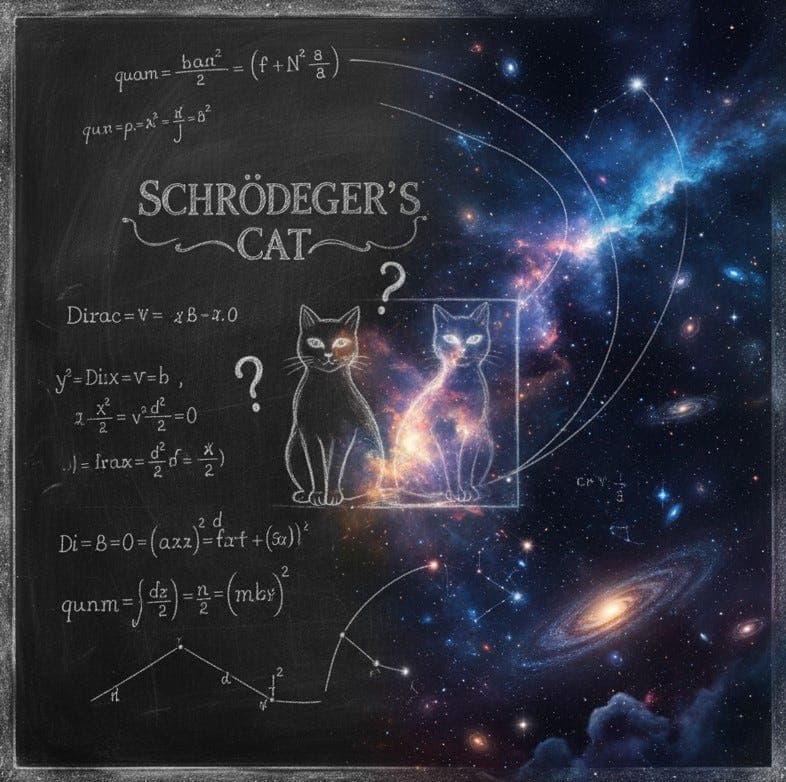
From Gödel’s incompleteness to Penrose’s gravity — exploring the gap in the code of the universe.
I grew up finding comfort in numbers. In a world that was often loud and unpredictable, mathematics offered a sanctuary of order. If you follow the rules, you get the answer. 2 + 2 always equals 4. Code compiles, or it doesn’t.
When I first started studying quantum computing, I expected to find that same rigid consistency. I fell in love with the logic of qubits and gates. But as I dug deeper, I found something unsettling. At the very heart of quantum mechanics — the most successful physical theory we have — there is a crack.
The more we learn about the quantum world, the more we realize that our current mathematical map might be missing a piece of the territory.
It turns out, the rules might not just be weird; they might be incomplete.
To understand this “gap,” we have to look at how a quantum computer actually runs. Roger Penrose, the Nobel Prize-winning physicist, points out that quantum theory isn’t actually one process. It is two contradictions glued together.
Let’s look at this through the lens of code. If you use Qiskit (IBM’s quantum SDK), you are actually engaging with these two distinct physical regimes.
Regime A: Unitary Evolution (The Schrödinger Equation)
This is the smooth, elegant math. It describes how a quantum system evolves. It is deterministic, reversible, and keeps information intact. In code, this is when we apply gates.
from qiskit import QuantumCircuit

# 1. The Smooth Evolution (Unitary)
# We create a qubit and put it in a superposition.
# According to Schrödinger, this state evolves perfectly smoothly.
qc = QuantumCircuit(1, 1)
qc.h(0)  # The Hadamard gate creates a perfect 50/50 superposition
At this point in the code, the qubit is beautifully balanced. It is both 0 and 1. The math works perfectly.
Regime B: The Measurement (The Collapse)
Then comes the command that breaks the symmetry.
# 2. Measurement
# We force the universe to choose.
qc.measure(0, 0)

# This simple line of code hides the biggest mystery in physics.
# The smooth wave function "snaps" instantly to 0 or 1.
The problem? The first block of code (Regime A) says the system should stay in a superposition forever. The second block (Regime B) says, “Stop that. Pick one.”
The math doesn’t explain how or why we switch from A to B. We just type .measure() and accept it. Penrose argues that nature shouldn't rely on a "function call" to decide reality.
When Logic Hits a Wall
Why can’t we just write a better equation to explain the collapse? Penrose looks outside of physics to a mathematician named Kurt Gödel.
In the 20th century, Gödel rocked the mathematics world with his Incompleteness Theorems. He proved that in any complex system of rules (like math or code), there are statements that are true but cannot be proven by the rules themselves.
Imagine a computer program trying to verify its own truthfulness:
def godel_paradox():
    statement = "This statement cannot be proven true by this code."

    if is_true(statement):
        return "System is Incomplete" (True, but unprovable)
    else:
        return "System is Inconsistent" (False)
Truth is larger than proof.
Penrose applies this to the human mind. He argues that because we can understand truths that algorithms cannot prove, our brains (and by extension, the universe) must be using a physics that is non-computational.
Standard Quantum Mechanics is computable. Therefore, it cannot be the whole story.
The Penrose Proposal: Gravity
If the standard model is just a “computable approximation,” where does the real, non-computational physics happen? Penrose believes it happens in the Collapse.
He proposes Objective Reduction.
He argues that we ignore Gravity in quantum mechanics because it’s usually too weak to matter at the atomic scale. But conceptually, gravity is the key.
- Superposition: A particle is in two places at once.
- General Relativity: Mass curves spacetime.
- The Conflict: If a particle is in two places, it is curving spacetime in two different ways simultaneously.
Penrose suggests that nature cannot handle this separation for long. The difference in energy makes the system unstable. Eventually, it self-measures. It snaps into one shape. Gravity causes the wave function collapse.

Why should we, as developers and researchers in quantum, care about this philosophical debate?
Because we are often taught to “Shut up and calculate.” We treat the measurement problem like a bug in the code that we just work around.
But Penrose’s ideas remind us that the map is not the territory. The equations we use to build quantum algorithms are incredible tools, but they are likely approximations of a deeper reality.
As we build the next generation of quantum computers, we are working on the edge of what is known. The “gap” in the math isn’t a mistake. It’s the space where the next great discovery is waiting.
Perhaps the next breakthrough won’t come from adding more qubits, but from understanding what happens in the silence between the gates.
Written by Arife Nur Ayaz.
Enjoyed this read? Support the author onMedium.
Reactions
Responses (1)
Join the conversation
Enter your name to start commenting.
I love this!