
Maryam Mirzakhani: The Woman Who Changed Mathematics by Refusing to Rush
January 29, 2026 • 3 min read
Girls in Quantum
Author
Wrote by: Fatima, Ambassador of Pakistan GIQ
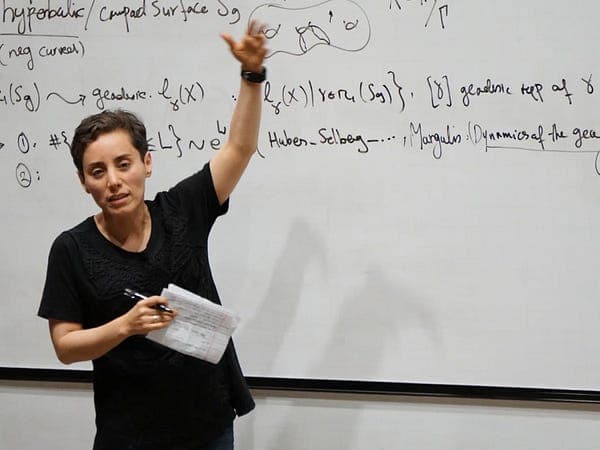
On the floor of her office, large sheets of paper lay open like unfinished maps. Curves crossed one another, arrows pointed nowhere obvious, and entire sections had been erased and redrawn. Maryam Mirzakhani sat among them in silence, thinking, not quickly, not performatively, but deeply.
This was her way of doing mathematics.
Long before the world knew her name, Mirzakhani was a young girl in Iran who did not believe she was exceptional. She struggled with mathematics early on and felt the quiet disappointment that many students especially girls, learn to internalize. She did not grow up surrounded by scientists or mathematicians. In fact, her first dream was to become a writer.
What drew her in was not numbers, but stories.
Over time, she realized that mathematics, too, was a form of storytelling a way of tracing hidden connections and giving structure to ideas that initially seem chaotic. That realization changed everything. She began to approach problems not as tests to pass, but as landscapes to explore.
Her persistence led her to international recognition as a teenager when she became the first Iranian woman to win gold medals at the International Mathematical Olympiad. Yet even this did not alter her temperament. Mirzakhani never chased attention. She chased understanding.
At Stanford University, where she later became a professor, colleagues observed something unusual. Mirzakhani worked slowly. She filled pages with drawings, discarded them, and began again without frustration. She embraced being lost. Confusion, to her, was not a weakness — it was a necessary stage of discovery.
Her research focused on the geometry of curved surfaces and abstract spaces, work that revealed deep connections between pure mathematics and theoretical physics. These ideas now influence areas ranging from geometry to quantum theory. Still, Mirzakhani spoke of her work with humility, describing it as a long conversation with difficult questions rather than a series of breakthroughs.
In 2014, history quietly shifted. Maryam Mirzakhani was awarded the Fields Medal, the highest honor in mathematics. She was the first woman ever to receive it.
The announcement sent ripples across the world. For many women in science, it was a moment of stillness a recognition that something long considered unreachable had finally been claimed. Not loudly. Not defiantly. But undeniably.
Mirzakhani herself resisted the symbolism. She spoke instead about encouragement, access, and the importance of allowing young people, especially girls, to imagine themselves in scientific spaces without fear.
“The beauty of mathematics only shows itself to more patient followers.”
— Maryam Mirzakhani
She passed away in 2017 at the age of 40. Her absence is deeply felt, but her legacy endures. Not only in the mathematics she transformed, but in the example she set: that brilliance does not require haste, that creativity belongs in science, and that quiet persistence can alter the course of history.
Maryam Mirzakhani did not redefine mathematics by trying to fit its expectations. She did so by reshaping them.
Enjoyed this read? Support the author onMedium.
Reactions
Responses (0)
Join the conversation
Enter your name to start commenting.
No comments yet. Be the first to share your thoughts!